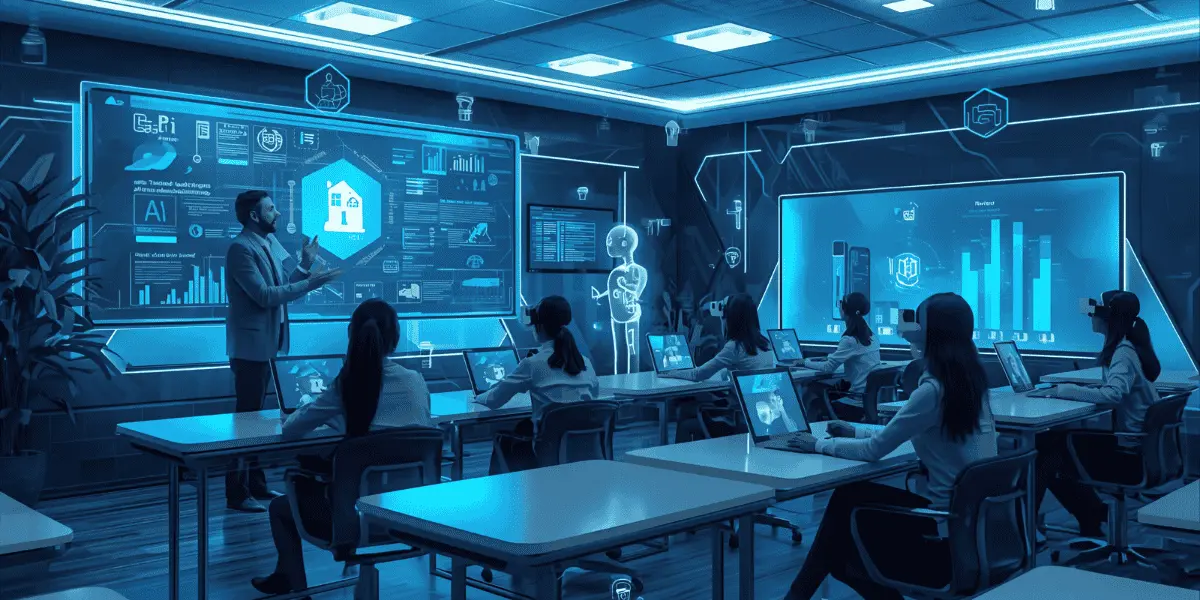
Forbes claims that by the year 2025 the global market of learning will reach 38 billion dollars with the help of artificial intelligence. AI will help educators develop personalized learning paths for diversified instruction. This is no longer hypothetical. It’s happening right now with artificial intelligence in education. In this post, we will examine the unique ways in which artificial intelligence is changing the dynamics of teaching, learning, and even administrative processes in schools and colleges. This blog focuses on the most recent trends, advantages, and practical applications of artificial intelligence in education in combination with the rest of the education system we currently have to devise ways for the future.
What are the uses of artificial intelligence in education?
As with every technological advancement, artificial intelligence in education focuses on and analyzes human intelligence attributes, which can be adjusted to technology. These attributes, which AI is set to mimic, include adapting, predicting, and providing feedback within a learning and teaching scenario on which to base actions.
Some of the necessary elements to realize AI in education include:
- Predictive analytics and machine learning focus on a learner’s past achievements and engagement and behavior and attempt to forecast future potential.
- Nature processing and generative AI, which use automatic and computerized tools to assist in students’ learning by reading and composing their text.
- Adaptive learning and intelligent tutoring systems; text that gives real students feedback on whichever volume of their real-time performance on which their content, pace, and difficulty level will be adjusted to.
- Bot technology deals with administrative tasks like grading, attendance, scheduling, and even detecting plagiarism, all in auto-mode and stealth!
These areas come together to create a new ecosystem comprising adaptive learning, AI tutorship systems, tools for educational data privacy, and much more.
Real-world applications and examples
The role of artificial intelligence in education has greatly transformed from the hard tools utilized in classrooms to the more concealed functions of the school. The various forms of application are listed below.
- Tools and platforms for use in the classroom
Mathematics and language adaptive learning platforms personalize the content presented to the learner according to the grade they achieve in a customized assessment. For example, some platforms are capable of generating various types of quizzes in a matter of seconds. The core version of a quiz, a much simpler version, and even an advanced variant of the quiz. What their use implies is the ease of scalable differentiation.
Systems that provide tutoring of all sorts collaboratively with AI, or intelligent tutoring systems, provide their users with explanations, hints, or examples at any requested interval. For instance, in 2025, a university reported that over 80 percent of its students utilized generative AI, which are chat-based tools, for help with course clarifications or to give them feedback for their tasks.
Automated grading and plagiarism detection systems: An instructor can complete an essay and a few short answer questions in a matter of minutes, checking the work for grammar, structure, and even originality. From this, it can be seen that ample time is freed for teachers, thus standardizing their evaluation mark.
Whether they are homework support bots or writing support bots, students use AI for outlining, text drafting, and revising. By early 2025, surveys indicated a sizable portion of students utilize AI tools on a weekly or daily basis for their schoolwork.
In-class aides/AI teaching aides: Some districts are experimenting with chatbots or teaching aides that respond to basic questions, allowing human educators to concentrate on more profound discussions. Nevertheless, the discussions on bias and the hidden concerns with these chatbots are troubling.
- Administrative & back-office functions
Predictive analytics for retention and identifying students at risk of dropping out: Systems identify students who are likely to fail or withdraw from school based on their participation and performance histories.
AI tools for optimizing scheduling, resource distribution, and rostering: Scheduling, classroom assignments, and teacher assignments are automated to minimize delays and conflicts.
Admissions, enrollment, and automated advising: AI chatbots respond to basic queries from students and parents, screen documents for applications, and provide automated recommendations for courses.
Policy & systemic rule compliance: Measures of academic dishonesty, data privacy, and ensuring that other departments maintain uniform practices.
Mini case studies
- Higher Education: A selective college in the U.S. in 2025 had 80% of its students stating they were using generative AI for their academic work. The institution then engaged in stress testing the assessments in addition to adjusting the guidelines to preserve fairness. There was varying adoption across disciplines that showed equity issues among student demographic groups.
- K-12 / District Level: Pearson in 2025 announced collaboration with Google to incorporate AI-based collaboration pedagogical aids in elementary and secondary education. The purpose was to provide adaptive instruction and to help teachers manage students more proactively.
Benefits and measurable impacts
Measurable gains in student outcomes, personalization, and teacher productivity demonstrate the positive impacts of artificial intelligence in education.
- Student outcomes and personalization
By mid-2025, more than 65% of students in higher education think that they know more about AI than their teachers, and they want more integration of AI in their education.
In global surveys, 86% of students report using AI in their academic work, with 54% using it on a weekly basis.
Retention improvements of 20-30% in some pilot programs have been achieved with adaptive systems using timely scaffolding and nudges.
Within the time space of the years 2024 and 2025, UK universities and colleges were reported to utilize AI with a percentage increase of 66 to 92. This trend demonstrates the dependence of pupils on the technology for their assignments as well as revisions.
As per the 2025 reports, 60% of educators are reported utilizing some sort of AI technology for planning, feedback, and overall content creation.
Taking into account the monotonous responsibilities assigned to instructors, such as grading and recording, the teacher grade to content and mentoring shift increases, and the teacher-to-mentor ratio is improved.
Educational projects that invest AI with a backbone strategy gain improved artist satisfaction along with a reduced dropout rate. The additional advantage of grading perfection is also experienced.
The bottom line states time, personalization, and informed-related decisions as the major takeaways.
Implementation recommendations for educational institutions
To integrate artificial intelligence in education in a safe and effective manner, institutions must develop a stepwise plan.
- Begin with small-scale initiatives.
- Involve stakeholders from the start.
- Enhance professional learning systems.
- Set a contract and review system.
- Create formalized policies for data management.
- Intentionally think about accessibility and equity.
- Evaluate, iterate, and scale gradually.
- Policy configurations and ethical guardrails require continuous reflection.
What are the expected changes in the next 3 to 5 years?
In the next few years, artificial intelligence in education is likely to incorporate deeper synergy with humans in the following ways:
- Increased integration of AI and humans.
- Multimodal, generative learning companions.
- Lifelong adaptive learning pathways.
- Investment surge & market growth.
- Stronger regulation and policy guardrails.
- More decentralization and personalization.
- Equity-focused AI ecosystems.
Conclusion
The advent of artificial intelligence in education is no longer just an idea of the future; rather, it is changing the way classrooms function, assisting teachers, and customizing the education pathways of students. However, the positive outcome resulting from its use is influenced by how it is applied, the level of access granted, and the continuous scanning for ethical implications.